
Science

Introduction
This chapter clarifies about the technique to discover the processes between knowledge
(the fundamental entity inside the realm of theory) and its counterpart the phenomenon
(the fundamental entity inside the realm of empiricism). The processes induced
by and between these two realms are regulated by an interface, which opens the
world for creating a solid pre-scientific method to evaluate scientific procedures.
The function of science shall be nothing else then generating facts by truth (= inference),
and it is important to emphasize at this moment, that these facts themselves are
not the truth even when generated by truth, because the truth is much more than
the facts derived from it. The human-initiated reduction of the truth to true facts
will cut the facts from truth and legitimates for creating believes (illusions)
corruptedly sold as truth by just extracting the true facts from the believe. The
perfect analogy for the problems with facts is the fact as the tip of the iceberg,
while the whole iceberg is the truth; now cut the tip of the iceberg from the rest
of the iceberg and you will have isolated the fact from the truth and by the way
no truth anymore. So remember that scientific facts by itself are therefore not
the truth but shall be operated by truth; and therefore serve the truth, which
the scienctific method is doing by excluding possibilities, those which are safe
to be excluded after their evaluation (possibilities are more than facts, because
they are context-realted). Science therefore may be safely marked as "The process
of truth by excluding possibilities"; so don't get fooled into those games by others
like: "That's a scientific fact and everything else, which don't consider the facts
marked as theory, is not valid and thus bullshit", just after someone has presented
a more or less worked-out new possibility; those games shall not work anymore,
because science can not judge about possibilities by just taking true facts without
adressing the same context (area of validity). A possibility, which embeds true
facts inside a context, must be safely excluded by empirical testing or shall be
replaced by another better possibility adressing the same context and not just
by any exchangeable true facts. This will distinguish between the ignorant and
the truthful operation; the end (fact) never justifies the means (the possibility,
which embeds the facts inside a context).
The awareness of those possibilities is, what knowledge is about, and something
which is not considered in science. Science officially sadly focusses on facts,
whose replaceability is a weak point of corruption; and what science mistakenly
calls knowledge, are facts by definition. For inspecting possibilities, science
not only needs to put the yet to be tested theory into the context of the desired
question, but shall also force the main picture (status quo) into retrospection
(see method of retroduction at the end of this chapter).
The first step for providing a system of examining and excluding possibilities
is the unification of three selected systems, which interfere with science and
is at the same time capable of regulating each other:
- System of Rationality
- Epistemology (= theory of knowledge)
- Information Technology
While Rationality is in itself the technique of science, information technology
uses pure logics. Between both resides epistemology, which originates from philosophy
and uses also the technique of logics as interface to rational questions. If all
three keep watching at science without resulting contradiction, then you have brought
a solid, universal and self-maintaining inspecting and sorting framework into being,
that approves the scientific scope.
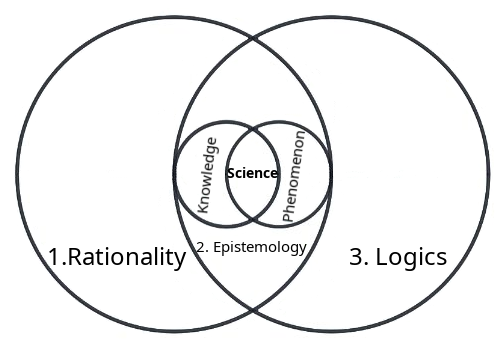
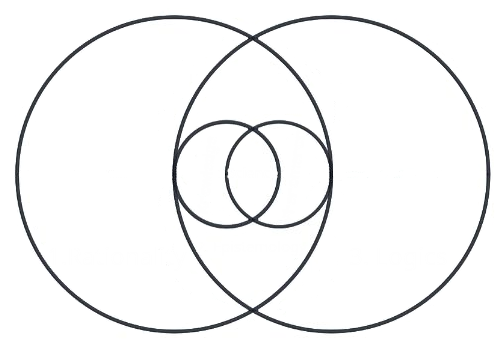
You might have noticed above that not one but two interfaces (between knowledge
[theory] & phenomenon [empiricism]; rationality [system of rationality] & logics
[IT]) have been already indicated, one embedded inside another, and thats why the
interrelation can be beautifully visualized by two nested Vesica Piscis.
Science – and its area of validity
The Hypothesis and Axiome have something for the most part in common: They both are disposition of possibilities. But the lesser part, which distinguishes both from each other, is the only significant "micro-state" that tells you, if the disposition behind it qualifies for a scientific process or not. Only those dispositions of possibilities, that are testable, qualify for scientific explorations. Hypotheses are the only dispositions, which are directly testable, while axiomes – although not directly testable – provide hypotheses by derivation, which again can be tested. So you may entitle axiomes as "indirectly" testable. The belief instead is just a claim, a proposition, which will be sold as fact and even as truth, and thus neither the scope of science nor related to it. Remember from the topic before: The true fact does not legitimate the claim of facts, even if the fact turns out to be true. Claiming of facts is not an operation of truth, if claims are stated as facts.
graph RL

  subgraph **Science area**
  direction RL
    A[(Hypothesis)]-->|Verification| D[Theory];
    A -->|Falsification| E[Myth];
  end

  subgraph **non-science area**
  direction TB
    B[(Axiome)];
    C[(Belief)];
  end

  B -.->|Corollary| A;
Rationality – the technique of science
Before diving into the science-chapters the clarification of the next lower-level terminology – namely about the most inflationary used word but only technique inside the area of scientific validity – shall be given and internalized.
An universal conceivable definition of rationality
The translation into a schematic diagram looks precisely like this:
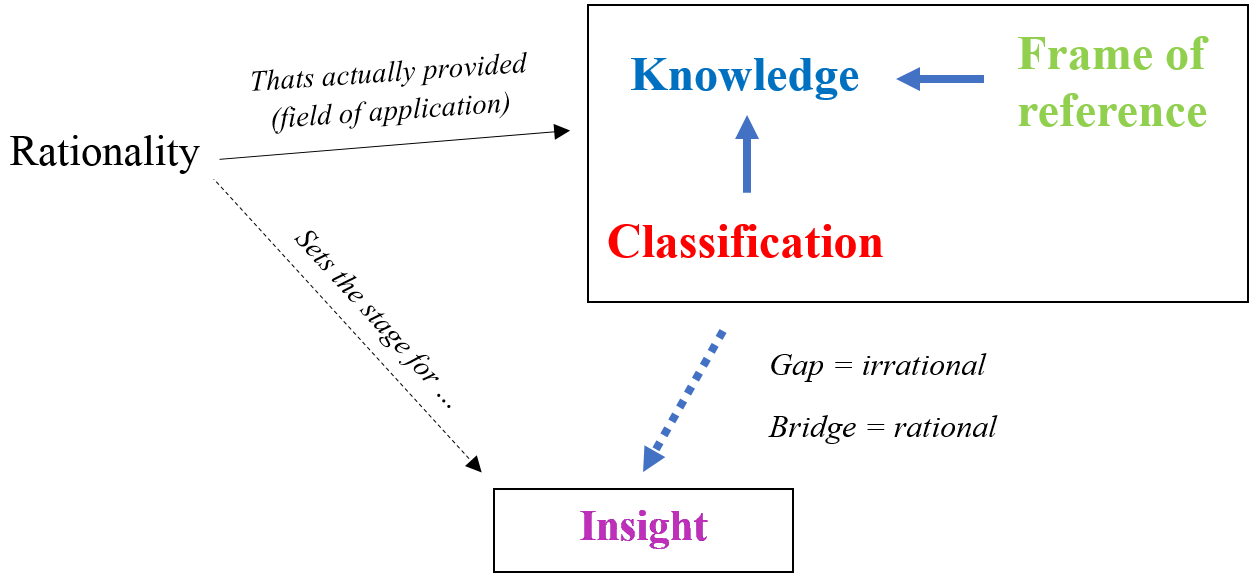
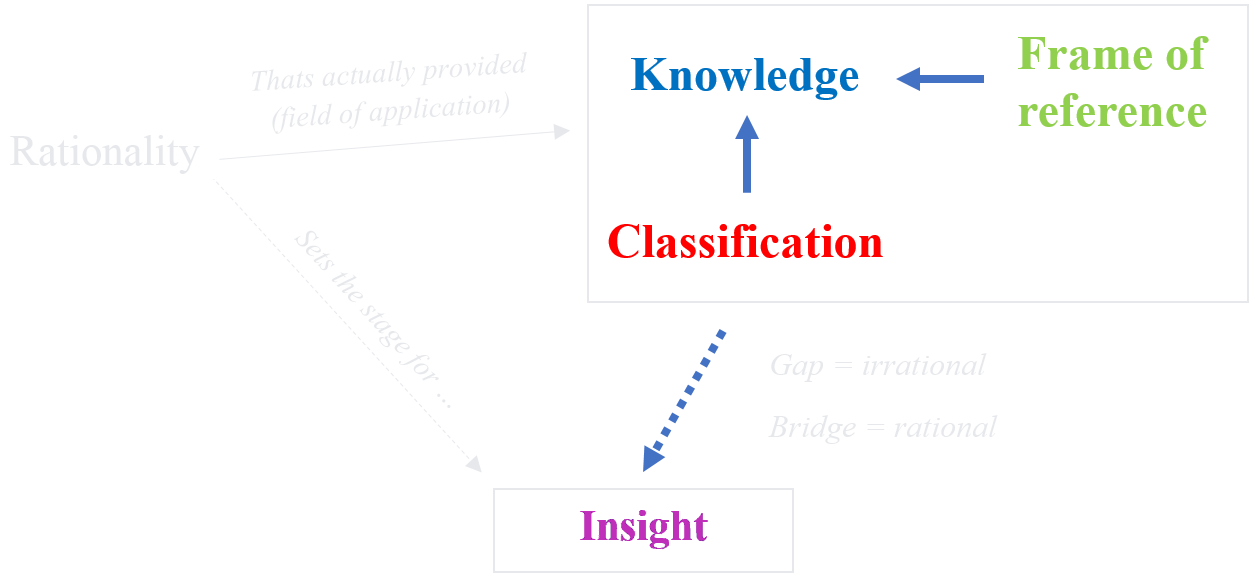
In summarizing words
The
Question:           Shall I walk at red light?

Knowledge:          Traffic regulations
Classification :    Crosswalk with Traffic light and cars
Frame of Reference: Crosswalk-situation (default routine without exceptions)

Insight:            No, there is no obvious reason to walk at red light.
                    Also it is safer to walk at green light!
Question:           Shall I walk at red light?

Knowledge:          Traffic regulations
Classification :    Crosswalk with Traffic light and cars
Frame of Reference: Crosswalk-situation (confused kid in middle of the crosswalk in danger)

Insight:            It it usually safer to walk at green light! But if you
                    keep staying at the traffic light, the kid could be a victim
                    for being hit by a car.
                    So there is a risk but an obvious reason to walk at red
                    light, in which the person could rescue the kid's life.
The case
The
So when being omniscient the
Two critical questions (one brought by the other) might rise, while discovering
the figure above; one of them: Why would
The answer helps clarify the term insight:
Another question rises about the so called
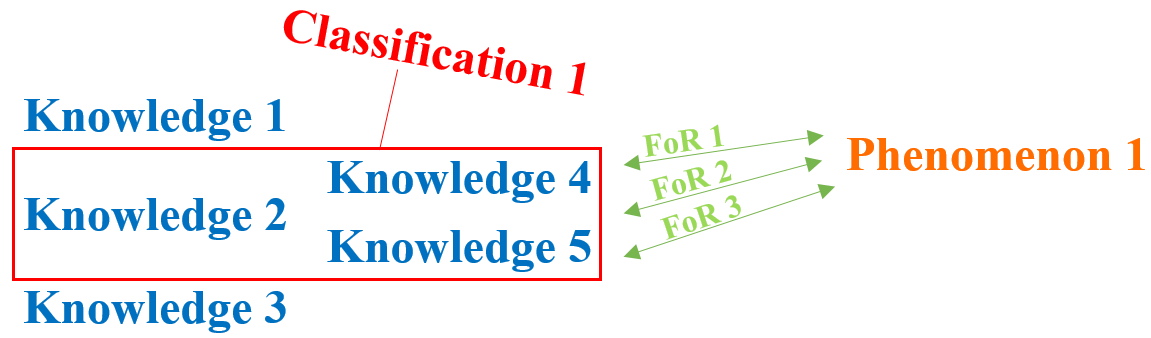
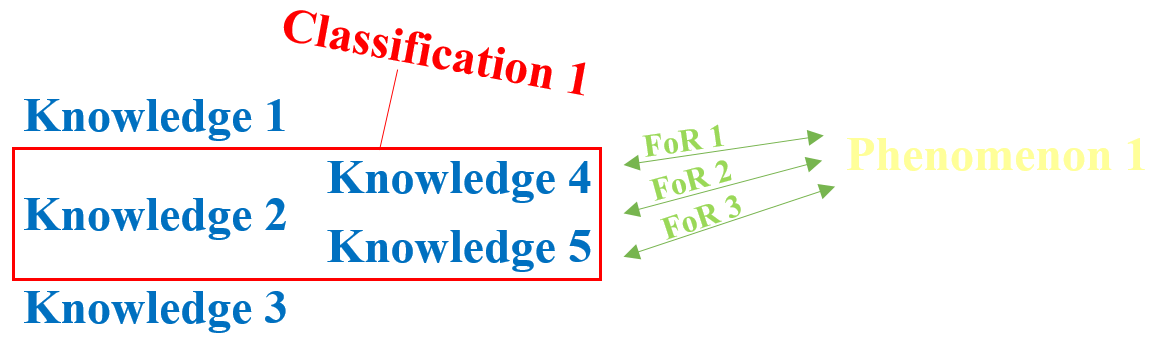
The answer is intriguing at first: The
This interface is not considered by conventional epistemology and shall later be implemented in detail as fruit of the whole chapter.
Mapping of Science by the Rational System, Epistemology and IT
In this topic we dive deeper by zooming-in and expanding the Rational System. This will be done by adding epistemology at first and then the terminology of IT carefully to it. Before going into the interactions between all three realms lets first list their qualities separate from each other:
| Rationality | Science | Science (detailed) | IT |
|---|---|---|---|
| Theory | By induction: New verified hypothesis; by deduction: Old verified hypothesis | Definition | |
| Theory | Sorting-Algorithm, by which the knowledge-elements will be sorted / categorized into models | Declaration | |
| Empiricism | Micro- or Macrocosmos (in general: Environment of experiment) | Declaration | |
| Empiricism | Observable-element inside the Frame of Reference | ------------- | |
| In general: Rational quintessence; By induction: New declared theory behind questioned phenomenon; by deduction: New Phenomenon behind its corroborative and declared theory | ------------- |
The analogon to IT is as follows: When the Source Code (= amount of knowledge)
grows the declaration won't be obvious anymore and the distinguishing between its
definition (=
Generally speaking about the Rational System, it is valid to say:
An analogy for clarifying about the Rational System
The
In the gold standard of epistemology theory and empiricism share its information
through the process of induction and deduction. Now if the system of rationality
is added to that, then by definitions presented we need to arrange
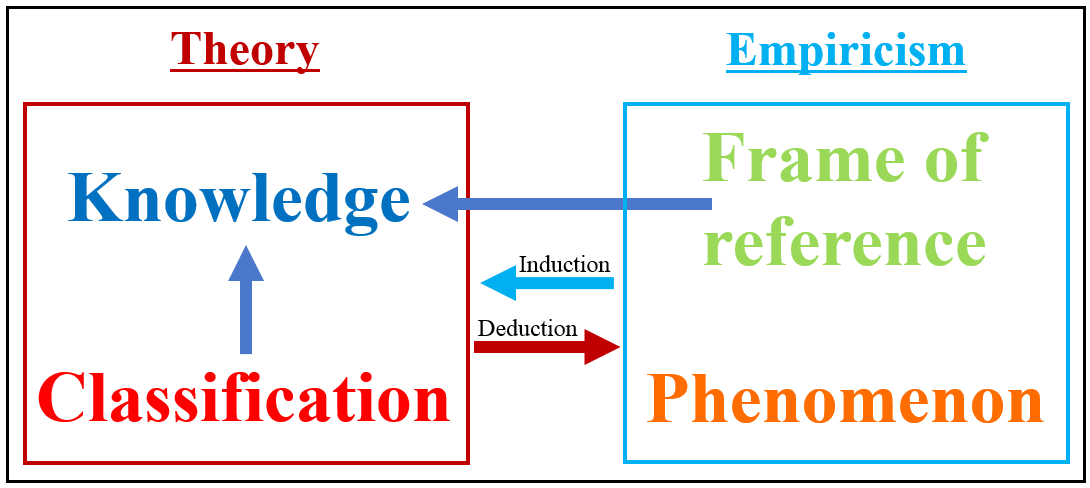
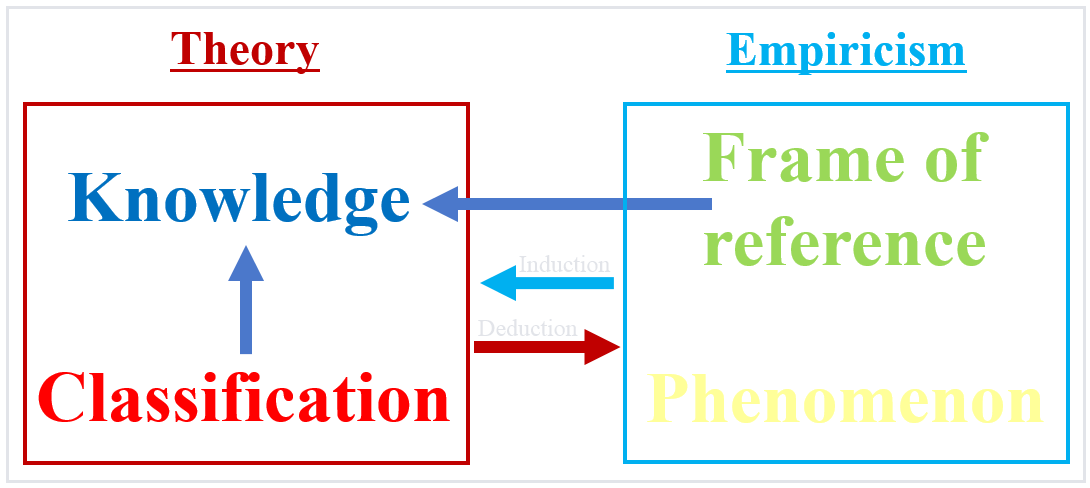
Now another conflict rises after fusing the rational system with epistemology by looking at the deduction-process: How may someone deduce empiricism from theory, if at the same time a single element from the realm of theory depends on another element from empriricsm?
It is a logical short circuit to explain the cause with its effect. It is simply not allowed in terms of causality and a scientific time-depending process always contains causality.
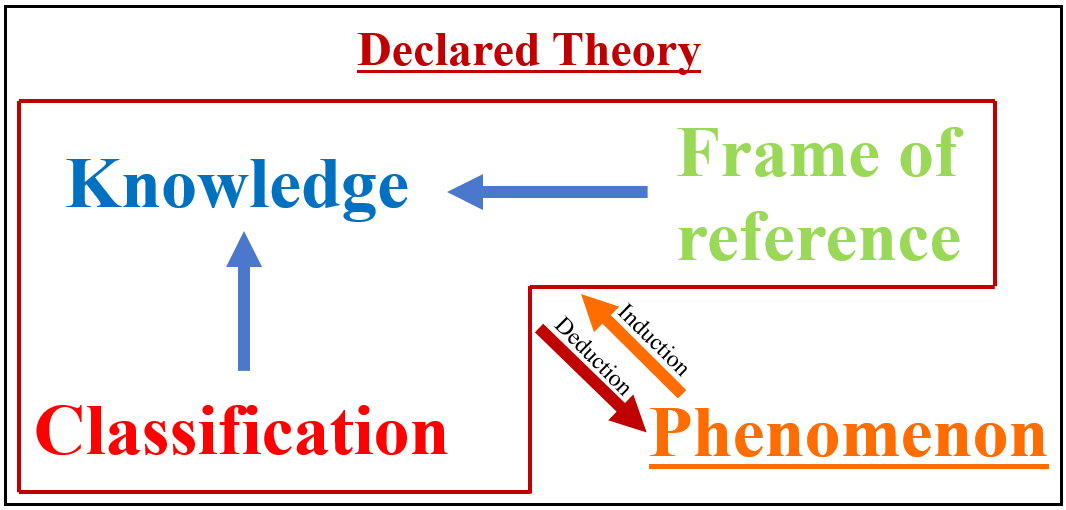
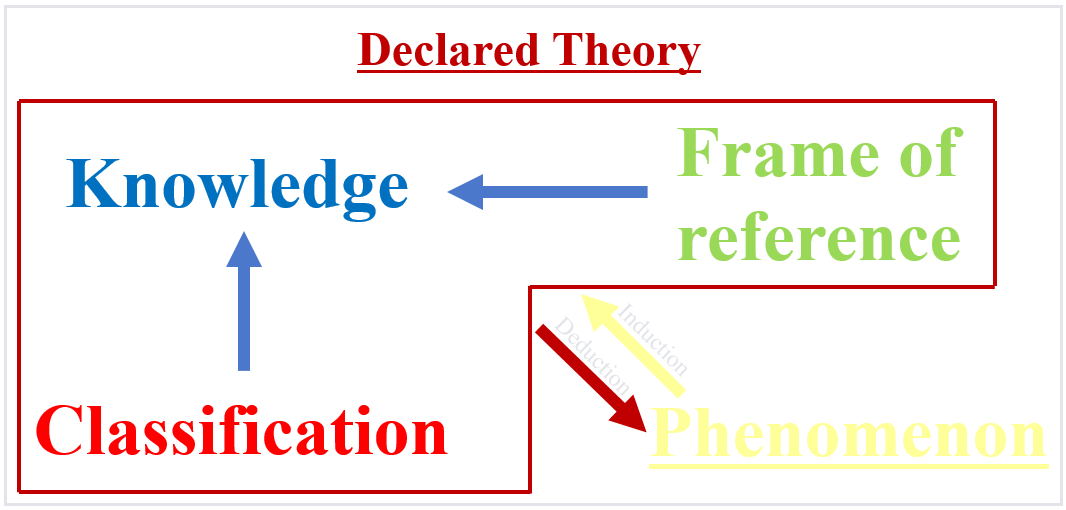
For this reason another way of the fusing the rational system with epistemology is the introduction of the "declared theory". Instead of dividing by theory & empiricisms we focus on declared theory & phenomenon, in which between the process of induction and deduction takes place.
The difference lies in a greater declaration of theory and thus in its complex
fingerprint and its unmistakable specific relation to a single
That means that the verification of a hypothesis must now identify as true-declared
theory – instead of insolently speaking of "true theory" – induced by / deduced
to the
Diving deeper into the framework for mapping of Science
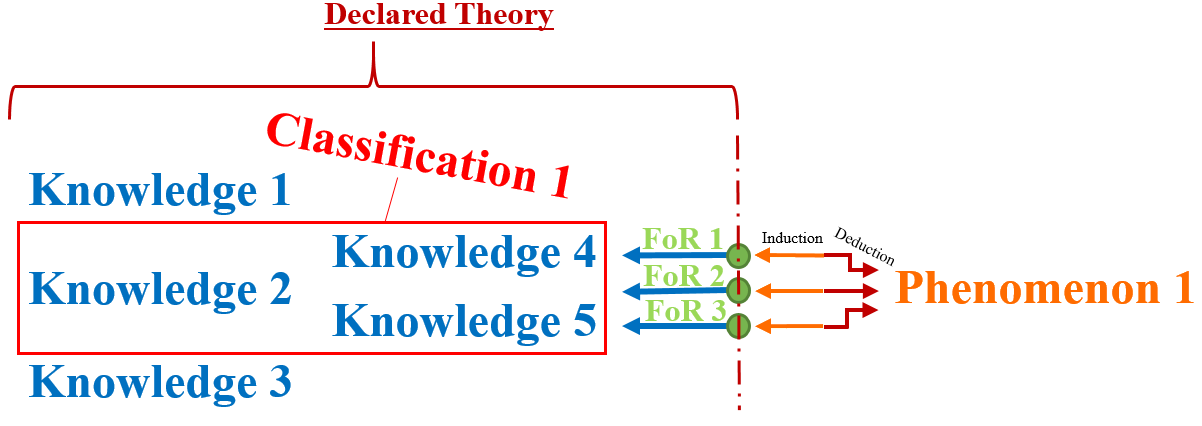
Now considering our analysis above of the rational system, information technology and common epistemology and its fusion altogether has lead to reconsidering epistemology and will consequently generate an framework for mapping of science-contents.
For this we look at two figures again and precise its deviation further.
The contradiction between both figures lies again on the
Retroduction – The third fundamental mode of reasoning?
While reading about the offical meaning of induction and deduction and expressing
it as two sides of the same coin and even advancing it by combining with other
valid systems, I came across the introduction of a third kind of process, which
has been later adopted into the debate: Retroduction. In short, It is a way
of saying, that induction is not capable of creating new knowledge (inference of
a rule) and deduction is not capable of discovering new
I don't see how retroduction differs from the analysis on this chapter,
that would make such a terminology necessary? The "declared theory" is always a
theory declared by the case, which is in our model the
I have a hard time to agree on the official story, when the initiation of both
processes (induction & deduction) already implies the "human" as initiator of cases,
so it would be trivial to create a new term for including a kind of "super-induction"
and "super-deduction" with its own logic, only to explain how to get free from
circling between "usual" induction & deduction, when you have no challenging cases
anymore. Out of reasoning itself yon creative idea will be born, that solve the
apparently endless circling around the solution, because reasoning – in whichever
mode of reasoning – doesn't compulsively exclude creativity. Following an idea
is a decision, and that decision – wether reasonable or not – shall be in any case
either thrown out or perfectly carried by going through and mastering this dual
process-nature of science for reaching the same goal, the solution, which creates
another but new feedback circle as knowledge grows; not even once a word about
"retroduction".
But again: The answer is only as good as the question, which implies the answer;
two sides of the same coin. If the question is bad, then induction & deduction
won't compensate for a better answer. So change the question, and you will be happy
after the induction & deduction of its answer. Now call the justification of asking
a better question "retroduction" and you get a picture of this comedy.
In other words: The official term "retroduction" has been created to give the narrow
but "justified" induction & deduction process a new degree of freedom (from old
circle to new circle of induction & dedcution), which will be fed by "adopted"
hypothesis only justified by creativity about facts. Period.
To get the original idea of retroduction on
your own look for "Collected Papers of Charkes Sanders Peirce" and more simplistic
RAMESES II Project